

Getting a question across
Before Arrival could show Louise Banks deciphering alien writing, its screenwriter had to make that writing understandable on paper. Eric Heisserer told The Credits that descriptions had clogged his screenplay with explanation. His wife, writer Christine Boylan, suggested drawing it. He made six circular symbols and inserted them manually into successive drafts, giving readers something concrete to look at.
Louise’s frustration with authority also came from home. In his Behind the Lens interview, Heisserer linked her treatment to what he had seen his academic father endure: knowledgeable people being overruled by outsiders. The impatience surrounding her work therefore had a familiar human source. She could know how to proceed and still struggle to get permission to do it.
Consultant Jessica Coon describes the practical obstacle in her chapter on the film. Before Louise can ask why the visitors have come, she needs smaller units of meaning. Even the concept of a question may lack a direct equivalent. Coon also stresses the first step that precedes collecting useful data: building a working relationship with the people whose language you study.
Building the writing
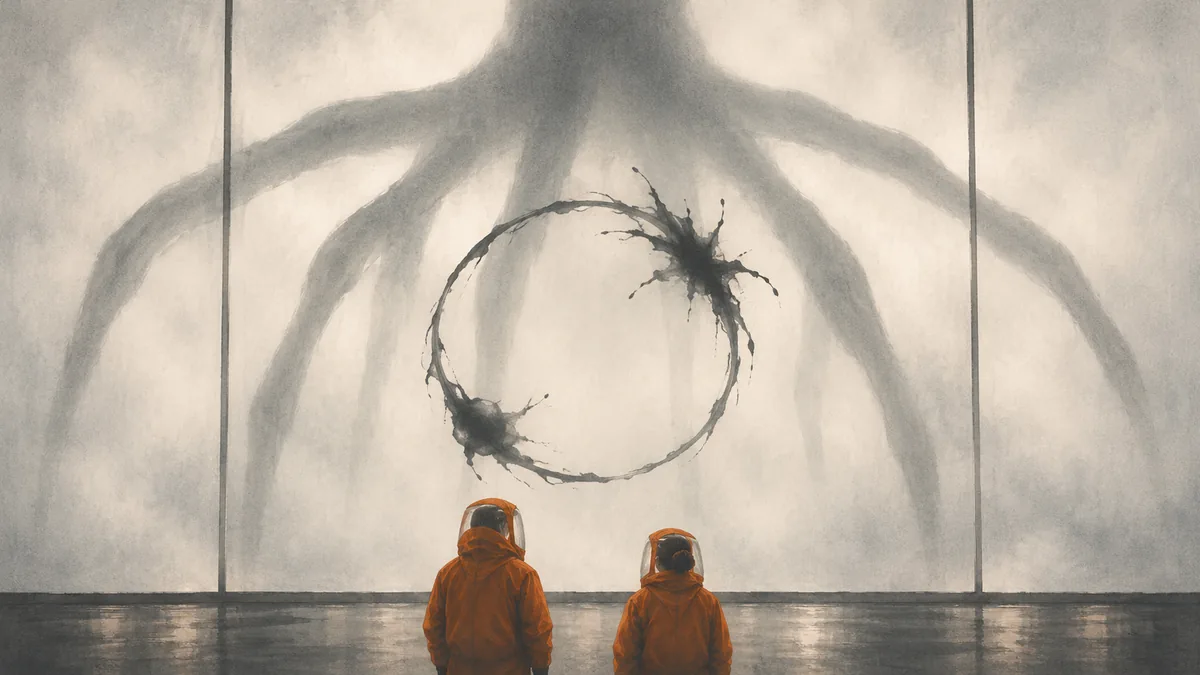
Production designer Patrice Vermette began with the visual problem. He told The Credits that research into terrestrial scripts kept producing designs that felt too human. The circular form needed to suggest a different relationship with time, without a beginning or end. Repeated shapes could then acquire meanings. Louise’s investigation required marks that the filmmakers themselves could break down and reuse.
In his Art Directors Guild account, Vermette credits artist Martine Bertrand with the logograms and describes Aaron Morrison dividing them into twelve parts. Selected shapes became a dictionary of words, ideas and feelings. Combining those pieces produced further messages. Like handwriting, the shapes could also vary with the writer or mood, giving the system room for differences within a recognizable pattern.
The ink needed a sound as it moved. Sylvain Bellemare told A Sound Effect that Nicolas Becker’s Foley recordings used vegetables and rice in water, plus metal brushes scraped over plastic. Mimi Allard assembled the small sounds into the logograms’ design. What appears to be an alien writing instrument thus involved a collection of wet, scratchy materials recorded in Paris.
The writing surface also lit the encounter. American Cinematographer’s production report describes the chamber’s light coming from behind the screen, with no lamps built into the ship’s walls. A huge sheet of muslin diffused the light. For Louise’s hand contact, the crew added Plexiglas so Amy Adams could touch something firm. The same boundary served the actor, the lighting and the imagined conversation.
Testing the conversation
Coon supplied another kind of physical detail. In her Our Languages blog interview, she recalls being asked to write a whiteboard task list as though an alien language had just arrived for analysis. Her annotations on logograms and books from her office also entered the film. The researchers’ surroundings included work that a linguist had actually been asked to think through.
Some displays performed real calculations. Stephen Wolfram reports that Christopher Wolfram wrote code to analyze the filmmakers’ material. In a shot rearranging alien writing, the visible program performs that transformation.
The editing determined how much research an audience could follow. Joe Walker told ProVideo Coalition that several scientific scenes inside the ship became material for a montage. He and Denis Villeneuve wrote Ian’s accompanying narration during postproduction. That arrangement gave the physicist more space and preserved the principal encounters with both researchers as distinct scenes, while making room for views of the wider world.
There is a limit to what all this work lets a viewer learn. Coon told Babel that the roughly one hundred logograms were artworks used consistently, rather than a complete language governed by expressive rules. Fans cannot study them as they might Klingon. She nevertheless found writing a sensible choice for Louise: a human voice cannot reproduce the heptapods’ nonhuman sounds.